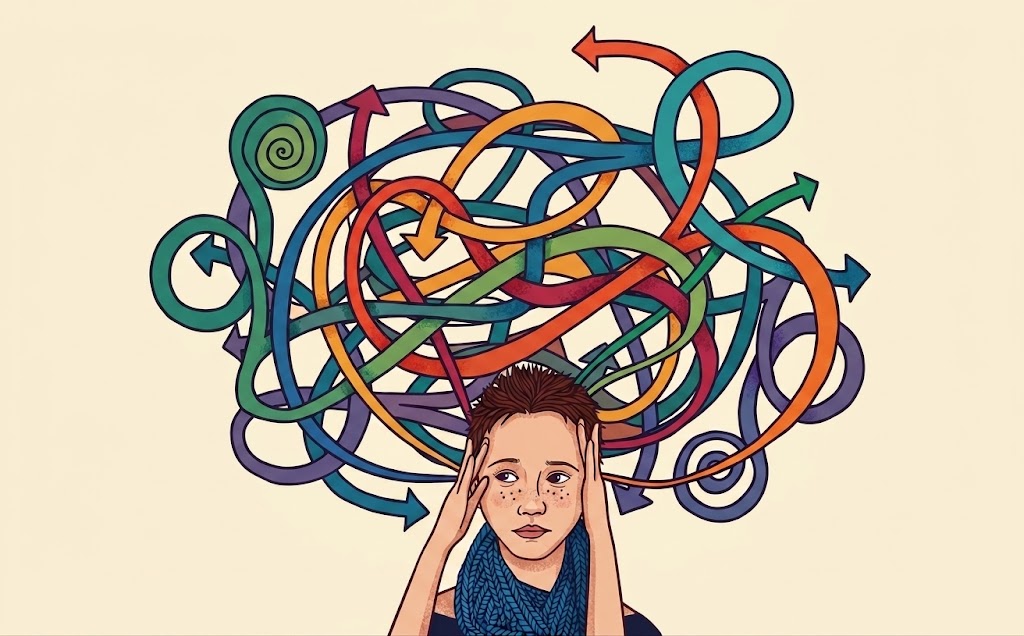
Replaying a past conversation over and over, questioning whether a decision was the right one, or repeatedly analysing why a negative event occurred are experiences many people have from time to time. However, when these thoughts become repetitive, difficult to disengage from, and begin to consume significant mental energy, they may reflect a psychological process known as rumination.
Rumination refers to repeatedly focusing on distressing experiences, emotions, or problems without moving towards a clear resolution. A person may feel that they are trying to understand or solve a situation, yet repeatedly returning to the same thoughts can intensify anxiety, stress, and emotional distress.
What Is Rumination?
In psychology, rumination generally describes a repetitive pattern of thinking about negative experiences, their causes, and their possible consequences. Ruminative thoughts are often focused on the past and may involve questions such as “Why did this happen?”, “Why did I say that?”, “What if I had acted differently?” or “How did I not see this coming?”
An important characteristic of rumination is that thinking does not necessarily develop into productive problem-solving. Reflecting on an experience is not inherently unhealthy. Thinking about what happened, learning from mistakes, and considering possible solutions can be constructive.
With rumination, however, reflection becomes repetitive. Rather than developing a new perspective or identifying a practical next step, the mind repeatedly returns to the same questions and concerns.
As a result, a person may feel mentally exhausted without feeling any closer to resolving the issue.
What Causes Rumination?
There is no single cause of rumination. Personality characteristics, previous experiences, stress levels, emotional regulation, and coping strategies may all contribute to the development of repetitive thinking patterns.
Rumination may be particularly noticeable in people who find uncertainty difficult to tolerate, hold themselves to very high standards, or experience a strong need to understand and control situations. Perfectionism and excessive self-criticism can also contribute to ruminative thinking.
For example, a person may repeatedly analyse a past event because they believe that fully understanding what went wrong will prevent a similar situation from happening again. In this sense, rumination can sometimes represent the mind's attempt to reduce uncertainty and restore a sense of control.
However, repeatedly analysing a situation does not always create greater certainty. Instead, it may increase emotional distress and mental fatigue.
Rumination and Overthinking
Rumination is often associated with overthinking, and the terms are sometimes used interchangeably. Although they overlap, they are not exactly the same.
Overthinking can involve excessive analysis of past, present, or future situations. Rumination tends to involve repetitive thinking about past experiences and the negative emotions associated with them.
For example, repeatedly imagining everything that could go wrong during an upcoming meeting may be a form of anxious overthinking. Replaying a conversation from several days ago and repeatedly asking, “Why did I say that?” may be more characteristic of rumination.
Both patterns can become emotionally exhausting when they are persistent and begin to interfere with everyday life.
How Does Rumination Affect Mental Health?
When ruminative thinking becomes persistent, it can have a significant impact on emotional well-being. Research has associated rumination particularly with depressive symptoms and anxiety.
Repeatedly revisiting negative experiences can keep attention focused on perceived mistakes, losses, disappointments, or failures. This may prolong emotions such as sadness, guilt, anger, shame, or inadequacy.
Rumination can also interfere with concentration. When the mind is repeatedly occupied with unresolved thoughts, focusing on work, education, relationships, or everyday responsibilities may become more difficult.
Sleep can also be affected. For some people, repetitive thoughts become particularly noticeable at night when external distractions decrease. Replaying conversations, analysing past events, or questioning previous decisions may make it difficult to fall asleep and can contribute to poorer sleep quality.
Relationships may also be influenced by rumination. Repeatedly analysing an argument, a partner's words, or a change in their behaviour can increase anxiety and may lead a person to interpret situations more negatively.
How Can You Manage Rumination?
One important step in managing rumination is learning to recognise the difference between productive reflection and repetitive thinking. Asking yourself, “Is this thought helping me understand something new or take action, or am I returning to the same point?” can help identify a ruminative cycle.
Redirecting attention towards the present moment, maintaining daily routines, engaging in physical activity, and writing thoughts down may help some people interrupt repetitive thinking.
The goal, however, is not necessarily to eliminate unwanted thoughts completely. Trying to force thoughts away can sometimes make them return more strongly. Instead, developing greater awareness of thoughts and learning to respond to them differently can be more helpful.
Rumination and Psychotherapy
When repetitive thoughts begin to significantly affect daily functioning, relationships, sleep, concentration, or emotional well-being, psychotherapy may help individuals better understand these patterns.
During therapy, it may be possible to explore when rumination occurs, which emotions trigger repetitive thinking, and what keeps the cycle going. Therapy may also address underlying themes such as uncertainty, control, perfectionism, self-criticism, and difficulties managing uncomfortable emotions.
Rumination is more than simply “thinking too much.” It can represent the mind becoming caught in an attempt to understand, control, or resolve a difficult experience. Recognising this cycle can be an important first step towards developing a more flexible and balanced relationship with one's thoughts.