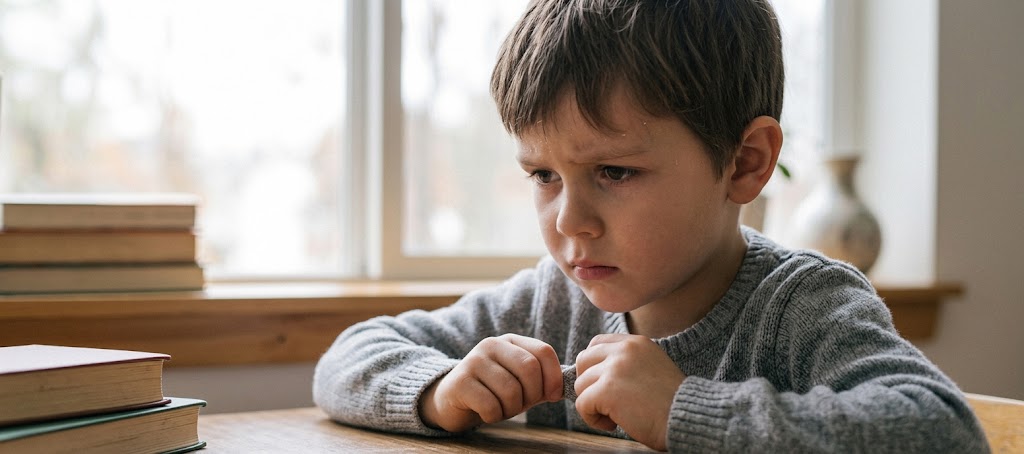
Anxiety in children does not always sound like “I am scared” or “I am worried.” Some children struggle to put feelings into words, while others express anxiety through anger, defiance, stomach aches, perfectionism, or restlessness. This can be understood as masked anxiety. Although anxiety is the underlying emotion, the outward behaviour may look very different. For this reason, it is important not to view a child’s difficulty only as a behaviour problem.
What Is Masked Anxiety?
Masked anxiety occurs when a child does not express worry, fear, or uncertainty directly, but shows it through physical, emotional, or behavioural symptoms. A child who feels anxious at school may have angry outbursts at home. A child with separation worries may complain of nausea in the morning. Another child may fear making mistakes in social settings and say, “I do not want to go,” become quiet, or repeatedly check their homework.
These reactions are not usually deliberate. Anxiety is a natural alarm response of the nervous system to a possible threat. When that alarm is activated too often or too intensely, however, it can affect daily life, school performance, sleep, and relationships.
Signs of Masked Anxiety in Children
Masked anxiety can look different from one child to another. Age, temperament, developmental stage, and current stressors all matter. Common signs include:
-
Recurrent stomach aches, headaches, nausea, or other physical complaints
-
Refusing school or showing intense resistance, especially in the morning
-
Irritability, tearfulness, sibling conflict, or sudden changes in behaviour
-
Difficulty falling asleep, nightmares, or a strong wish to sleep near a parent
-
Frequent reassurance-seeking, such as “Will you pick me up?” or “What if something happens?”
-
Difficulty tolerating mistakes, unfinished work, or perfectionistic tendencies
-
Avoiding social settings, withdrawing, or resisting unfamiliar activities
-
Nail biting, hair pulling, or skin picking as ways of managing tension
One sign alone does not mean that a child has an anxiety disorder. The key questions are how long the symptoms have lasted, how intense they are, and how much they interfere with the child’s daily functioning.
Why Can Anxiety Be Hidden?
Young children are still learning to recognise and describe emotions. Saying “My stomach hurts” may feel easier than saying “I have an uncomfortable feeling inside.” Older children may worry that sharing anxiety will make them look weak, or they may not want to upset their parents.
Family changes, moving home, starting school, exams, peer bullying, parental conflict, loss, and uncertainty can all increase anxiety. At the same time, anxiety rarely has one single cause. A child’s temperament, previous experiences, the anxiety level within the family, and environmental pressures can interact.
How Can Parents Respond?
A calm and non-judgemental curiosity about the feeling behind the behaviour can be helpful. Instead of asking, “Why are you angry again?” a parent might say, “I wonder whether something felt difficult today.” This can help the child feel safer and more understood. Physical complaints should not be dismissed; it is important to consider both their medical and emotional aspects.
Predictable routines can be especially regulating for anxious children. Consistent sleep, meals, school preparation, and screen-time boundaries support a sense of safety. Reassuring a child repeatedly may bring short-term relief, but it can unintentionally maintain the anxiety cycle over time. A more helpful response is brief and supportive: “I know this feels hard; we can make a plan together.”
Completely removing every feared situation can also strengthen anxiety. Instead, children benefit from facing challenges in small, age-appropriate, manageable steps. For example, when a child struggles with school attendance, parents and teachers can work together on a gradual return plan.
When Should Professional Support Be Considered?
It may be helpful to consult a child and adolescent mental health professional when symptoms continue for weeks and clearly affect school, friendships, sleep, appetite, or family life. Support should not be delayed when there is severe school refusal, persistent physical complaints, panic-like symptoms, comments about self-harm, or significant low mood.
Recognising masked anxiety in children means looking beneath the behaviour and noticing the need it may be communicating. With appropriate support, children can learn to name their emotions, cope with anxiety, and feel more secure.