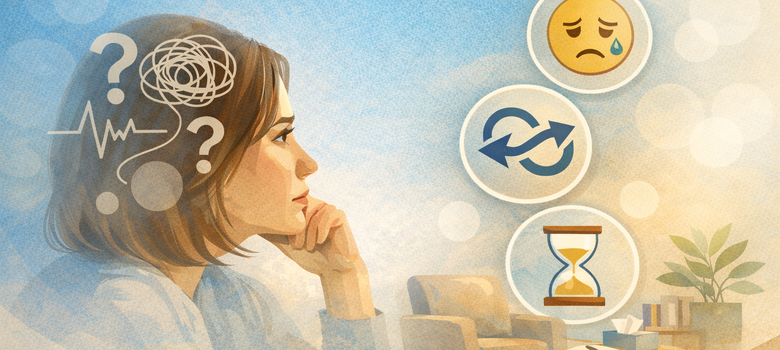
Your mind wanders during meetings or you regularly misplace your phone. When these difficulties persist and affect everyday life, you may wonder: Is it inattention or adult ADHD? The terms are not interchangeable. Inattention is a symptom; attention-deficit/hyperactivity disorder (ADHD) is a neurodevelopmental condition assessed using specific clinical criteria.
What can cause difficulty concentrating?
Concentration varies with our circumstances. Too little sleep, prolonged stress, burnout, anxiety, depression, and an overwhelming workload can all make it harder to focus. Constant notifications and repeated switches between tasks may also divide our attention.
Mistakes after several weeks of poor sleep do not establish ADHD. Consider when the difficulty began, how long it has lasted, and where it appears.
What are the symptoms of adult ADHD?
Adult ADHD is not defined by visible restlessness alone. Some people mainly experience inattention; others also experience impulsivity or inner restlessness. Examples can include:
- Missing details or making careless mistakes
- Finding it difficult to maintain attention during lengthy tasks
- Struggling to plan, prioritise, or complete work
- Forgetting appointments or daily responsibilities
- Frequently losing belongings or being easily distracted
- Interrupting others, struggling to wait, or feeling internally restless
Experiencing a few of these behaviours does not necessarily mean someone has adult ADHD. A clinical assessment considers whether symptoms have persisted, occur in more than one setting, and significantly affect daily life. ADHD begins in childhood, although it may not be recognised until adulthood. A later diagnosis does not mean the condition itself started later.
How can inattention and adult ADHD be distinguished?
One important clue is the pattern over time. A person may begin having trouble concentrating during a period of intense stress and notice an improvement when that stress eases. With ADHD, a clinician explores a longer history of difficulties across different parts of life. An adult might recall frequently forgetting school materials, struggling to finish homework, or needing unusually elaborate systems to stay organised.
The effect on everyday functioning also matters. Everyone procrastinates or forgets things occasionally. When missed deadlines, repeated mix-ups, or difficulties in relationships become persistent and disruptive, an assessment may be helpful. Sleep difficulties, anxiety, and depression can mimic or coexist with ADHD.
Does ADHD always look like hyperactivity?
Despite its name, ADHD does not always look like someone being unable to sit still. An adult may appear calm while experiencing mental restlessness, difficulty managing time, or trouble shifting between tasks. Calendars and alarms may make these difficulties less visible.
Success at school or work does not rule out ADHD; the effort required to achieve it also matters. No single habit confirms a diagnosis.
How is adult ADHD assessed?
There is no single online test that can diagnose ADHD. A qualified healthcare professional reviews current concerns, childhood experiences, school and work history, relationships, and the effect of symptoms on daily functioning. Questionnaires can help; other possible causes must also be considered.
Before an appointment, you might note when your concentration problems began, whether they occur at home as well as at work, and how sleep or stress affects them. Self-observation helps describe the problem; it does not replace a professional assessment.
When should you seek support?
If attention difficulties have lasted a long time, interfere with responsibilities, or affect your relationships, speaking with a qualified mental health professional is a reasonable next step. Support depends on what the assessment finds. When ADHD is identified, treatment options can be discussed. If sleep problems, anxiety, or another factor is contributing, support can address those needs too.
The distinction between everyday inattention and adult ADHD cannot be made from a short list of symptoms. It emerges from understanding a person's developmental history and present circumstances together. A careful evaluation offers a clearer basis for deciding what kind of help would be useful.