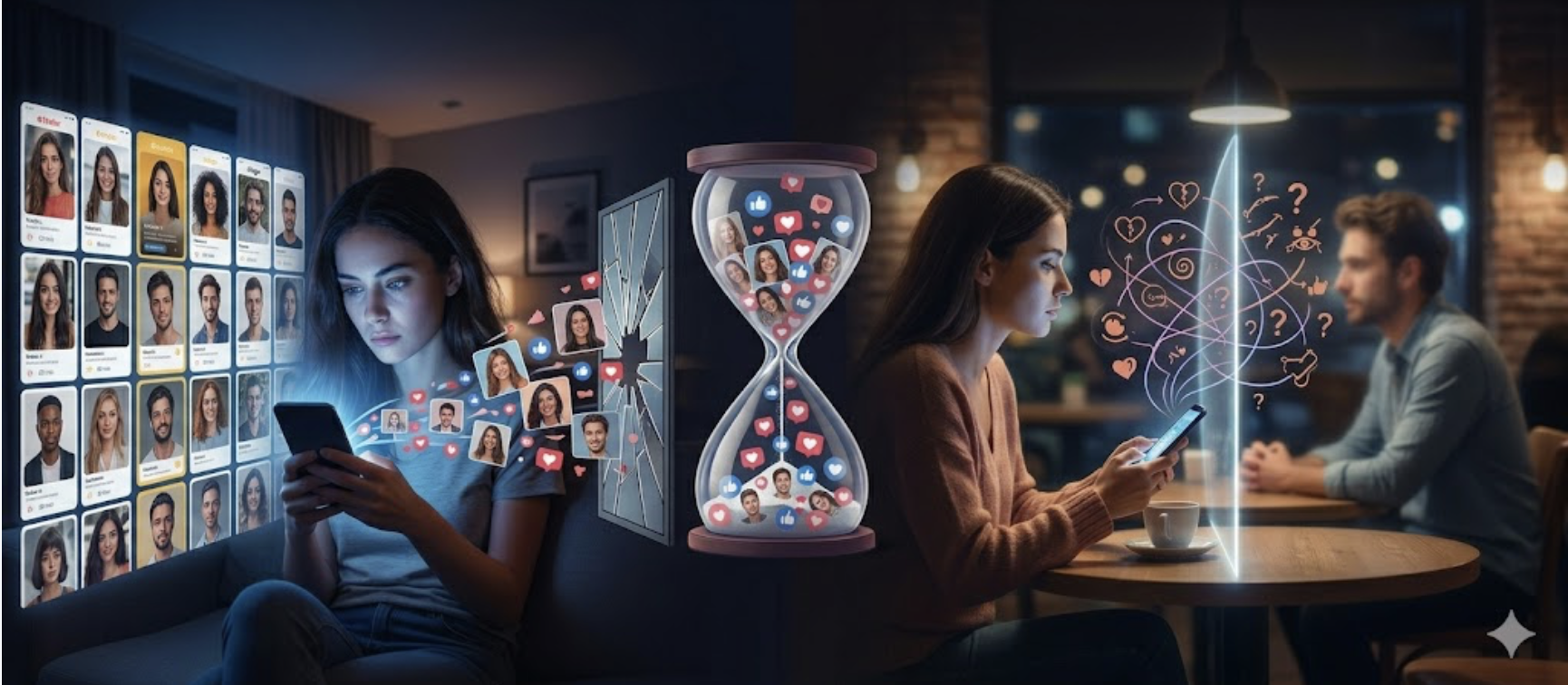
A Psychoanalytic Perspective on Tinder Culture, Choice Overload, and Dissatisfaction
Over the past decade, dating applications such as Tinder, Bumble, and Hinge have fundamentally transformed the way people meet and form romantic relationships. Connections that were once established through social circles, workplaces, or mutual friends are increasingly initiated through digital platforms. While the ability to connect with hundreds of potential partners within minutes may seem liberating, many users report feeling more uncertain, more dissatisfied, and sometimes even lonelier despite having more options than ever before.
Why does this happen?
From a psychoanalytic perspective, the issue is not simply about technology—it is about the nature of desire itself.
Why Desire Is Drawn to What It Cannot Fully Possess
One of the central ideas in psychoanalysis is that desire can never be completely satisfied. Human beings tend to desire not only what they have, but also what they perceive as lacking. As a result, desire often loses some of its intensity once it is fully obtained.
Dating applications create a unique environment for this dynamic. A match may provide a brief sense of excitement and gratification. Yet immediately afterward, countless new profiles, possibilities, and potential connections appear. The focus can gradually shift from building a meaningful relationship to pursuing the next possibility.
In this sense, the object of desire may no longer be another person, but rather the endless promise of new opportunities.
Is Having More Choices Really Freedom?
Modern culture often teaches us that the more choices we have, the happier we will be. Psychological research, however, suggests that an abundance of options can sometimes produce the opposite effect.
Dating applications expose users to hundreds or even thousands of potential partners. While this may initially feel empowering, it can also make commitment more difficult. Every choice inevitably means giving up other possibilities.
As a result, many people find themselves asking:
"What if there is someone even better out there?"
This mindset can prevent individuals from investing deeply in existing relationships. Rather than engaging with the person in front of them, they may remain preoccupied with an idealized partner who has yet to appear.
Are We Meeting People or Profiles?
On dating apps, first impressions are often based on a few photographs and a short biography. This can encourage us to perceive others not as complex human beings, but as collections of attractive or unattractive traits.
From a psychoanalytic perspective, people often fall in love not only with another person but also with the fantasies they project onto them. Digital environments amplify this tendency because they provide limited information, leaving plenty of room for imagination.
When a real relationship begins, disappointment may emerge. Real people inevitably differ from the idealized images we create in our minds.
The challenge is not that reality is flawed; it is that fantasy is often impossible to live up to.
The Addiction to Matching
For some individuals, dating applications become more than a tool for finding relationships. They can evolve into a way of regulating self-esteem.
Receiving a new match, a message, or a notification may temporarily make someone feel attractive, desirable, and valued. Yet these feelings are often short-lived, creating a need for repeated validation.
In such cases, the primary goal may gradually shift from forming meaningful connections to seeking reassurance that one is wanted.
The application becomes less about intimacy and more about maintaining a sense of self-worth.
Why Do We Get Bored So Quickly?
Dating apps offer an endless stream of novelty. This constant exposure to new possibilities can make the natural rhythms of long-term relationships feel less exciting by comparison.
However, genuine intimacy develops slowly. Trust, emotional security, and deep attachment are not built in a matter of days. They emerge through time, vulnerability, and shared experiences.
When alternative options are always visible, people may be tempted to escape ordinary disappointments rather than work through them. As a result, they may meet many people but struggle to establish meaningful emotional bonds.
Conclusion
Dating applications are neither inherently good nor bad. For many people, they provide opportunities to form valuable and lasting relationships. At the same time, they reveal important truths about contemporary desire, validation, and the search for connection.
From a psychoanalytic perspective, the most important question may be:
Are we truly searching for another person, or are we searching for something within ourselves that we believe the other person can complete?
Perhaps one of the most significant lessons dating apps offer is that desire is never solely about the other person. It is also about our relationship with ourselves, our fantasies, and our sense of what is missing.